
Slate Roof Replacement in Harrison Avenue, Kearny, NJ
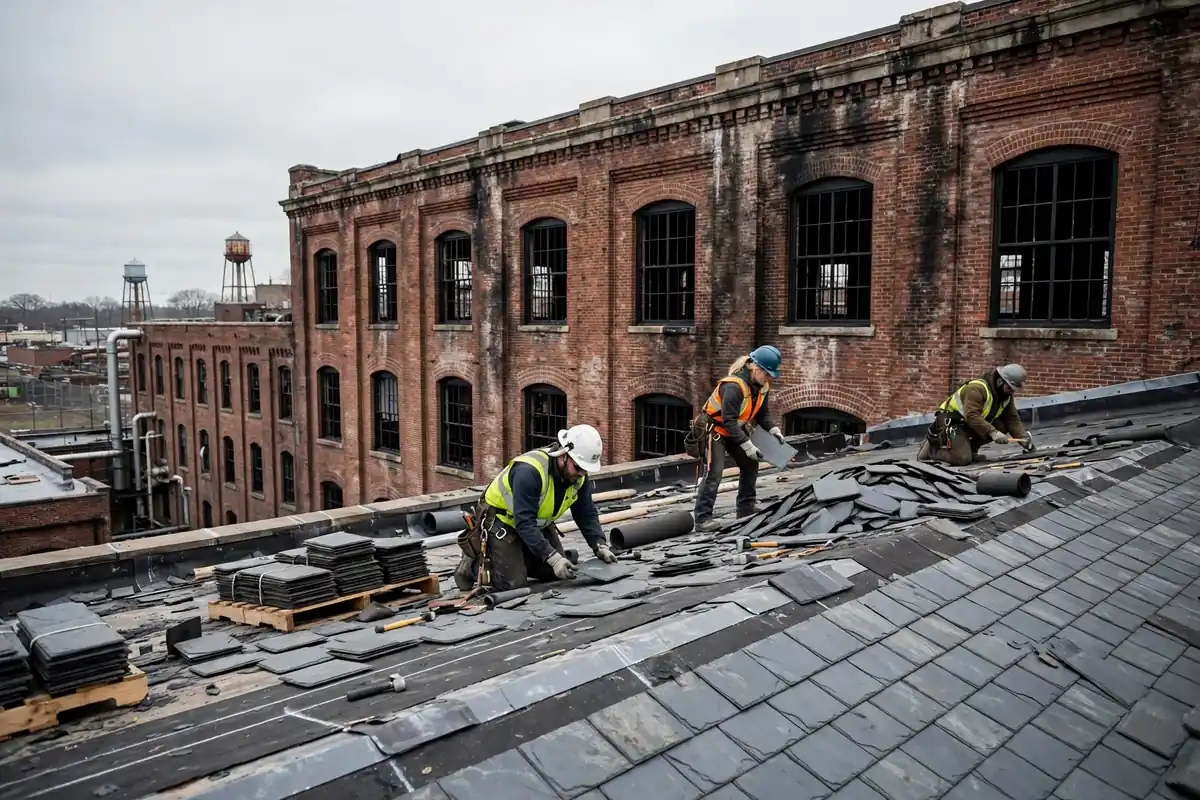
Roof Replacement Team provides slate roof replacement in Harrison Avenue, Kearny, NJ — Natural and synthetic slate replacement in Kearny — copper flashing and traditional craftsmanship built for a century. Harrison Avenue is the commercial-residential corridor running toward neighboring Harrison across the Passaic River. We handle both storefront low-slope roofing and the family homes set just behind the avenue. Serving Harrison Avenue, Kearny, NJ 07032.
Choosing slate roof replacement in Harrison Avenue means matching the system to the house. Kearny's nor'easters, snow, and humid summers take a steady toll on roofs across Harrison Avenue. We scope every project to your home's age, structure, and exposure — then install it to manufacturer spec.
Why Slate Makes Sense in Harrison Avenue
Harrison Avenue is the commercial-residential corridor running toward neighboring Harrison across the Passaic River. We handle both storefront low-slope roofing and the family homes set just behind the avenue. That's exactly the kind of housing where slate roof replacement pays off: the right system for the roofline, installed once and installed right. Natural and synthetic slate replacement in Kearny — copper flashing and traditional craftsmanship built for a century.
Materials We Recommend for Harrison Avenue Roofs
Kearny's nor'easters, snow, and humid summers take a steady toll on roofs across Harrison Avenue. Homes here typically wear architectural shingles are the standard replacement, with slate restoration on historic homes and TPO/EPDM on flat roofs — and ice dams and aging roofs mean small issues escalate fast. For slate roof replacement here, we specify materials rated for those exact conditions — Natural and synthetic slate replacement in Kearny — copper flashing and traditional craftsmanship built for a century.
How We Handle Slate Roof Replacement in Harrison Avenue
Every slate roof replacement in Harrison Avenue starts with a free on-site estimate and photo inspection. On install day we protect landscaping and siding, tear off to the deck, replace damaged sheathing, and build the new system layer by layer — underlayment, flashing, and finish. We handle both storefront low-slope roofing and the family homes set just behind the avenue. We finish with a full magnetic sweep and a final walkthrough with you.
Roofing on Harrison Avenue, Kearny, NJ 07032
Harrison Avenue is Kearny’s working corridor: warehouses, industrial buildings, auto and commercial shops, and commercial properties running from the Passaic River toward the Harrison town line. The roofs here are big, flat, and hardworking — tens of thousands of square feet of membrane carrying HVAC units, exhaust fans, vents, and decades of service traffic. Replacement on Harrison Avenue is capital planning, not home improvement: the questions are lifespan, disruption, drainage, and documentation, and the answers come from moisture surveys and core cuts, not curb appeal.
Common Roof Types on Harrison Avenue
EPDM and modified bitumen dominate the older industrial roofs — decades-old black rubber and multi-ply systems, many with patch histories that read like tree rings. TPO is the standard for new replacements: heat-welded seams, white reflectivity cutting summer heat load on cavernous unconditioned spaces, and good chemical resistance. Built-up (BUR) roofs survive on some of the oldest buildings. The universal features: minimal original slope (dead flat is the norm), parapets or gravel stops at the edges, large rooftop equipment populations, and drains that have been neglected since installation. Ponding is not a risk here; it is the existing condition.
Local Factors That Change the Work Here
Scale and drainage dominate. A Harrison Avenue replacement is primarily a drainage-correction project wearing a membrane replacement’s clothes: tapered insulation designed per-building to move water to drains and scuppers, new sumps, crickets around the rooftop equipment that currently dams water. Operations continuity is second: these are working businesses, so phasing keeps every section watertight nightly, crane picks and deliveries are scheduled around truck traffic and shifts, and interior protection goes under active zones. The river proximity is third: the corridor’s low elevation and flood history mean we discuss flood-zone implications for rooftop equipment and drainage discharge honestly — the roof must shed water even when the ground cannot.
What Replacement Day (and Week) Looks Like on Harrison Avenue
Think weeks, not days: a 20,000-square-foot warehouse roof phases across two to four weeks depending on deck condition and equipment density. It starts with the moisture survey and a phasing plan you approve — which sections when, where the crane sets, how truck access stays open. Each phase tears off, re-insulates with tapered slopes, membranes, flashes, and goes watertight before the next opens. Daily cleanup is industrial-grade: this corridor runs on trucks, and the site stays navigable. Closeout brings the warranty paperwork, as-built drawings of the tapered layout, drain test records, and the photo file — the documentation package a commercial owner actually needs.
| Neighborhood | Harrison Avenue — industrial/commercial corridor, Kearny, NJ |
|---|---|
| ZIP Code | 07032 |
| Housing stock | Warehouses, industrial buildings, commercial shops; large flat footprints |
| Common roof types | EPDM, modified bitumen (older); TPO (new work); some built-up roofs |
| Streets & landmarks | Harrison Ave corridor; Passaic River; Harrison town line; Lincoln Hwy connections |
| Key local challenge | Dead-flat decks with chronic ponding; equipment-crowded roofs; flood-zone elevation |
What's Included
- Reinforced decking assessment for slate's weight
- Traditional craftsmanship at hips, ridges, and valleys
- Century-plus lifespan with minimal maintenance
- Careful salvage and reuse of sound original slate where possible
- Weight-engineered fastening systems for steep slopes
Related Roofing Services
Skylight Replacement During Reroof
Replace aging skylights during your Kearny reroof — new units flashed directly into the new roofing system in Harrison Avenue.
Storm Damage Roof Replacement
Storm damage assessment, carrier-grade documentation, and full replacement for Kearny homes hit by nor'easters, snow, and humid summers in Harrison Avenue.
Asphalt Shingle Roof Replacement
Architectural shingle replacement for Kearny homes: full tear-off, new underlayment, and premium shingles rated for nor'easters, snow, and humid summers in Harrison Avenue.
Commercial Roof Replacement
Phased TPO, EPDM, and metal replacement for Kearny businesses — watertight throughout, minimal disruption in Harrison Avenue.
Slate Roof Replacement Near You
Slate Roof Replacement
Slate Roof Replacement across Kearny, NJ.
Harrison Avenue
All roof replacement services in Harrison Avenue, Kearny.
Slate Roof Replacement in Belgrove Drive
Slate Roof Replacement for Belgrove Drive homeowners.
Slate Roof Replacement in Forest Street
Slate Roof Replacement for Forest Street homeowners.
Helpful Guides
Roof Replacement for Historic Homes in Kearny: What to Know
Guide from Roof Replacement Team.
The Roof Replacement Process, Step by Step
Guide from Roof Replacement Team.
Frequently Asked Questions
How long does slate roof replacement take in Harrison Avenue?
Slate is craftsmanship work — most Harrison Avenue homes take one to two weeks. Every slate is individually hung and the flashing is custom-fabricated, which is why the result lasts a century.
Is natural slate too heavy for my Harrison Avenue home?
We assess the framing during the estimate. Many homes handle natural slate fine; where weight is a concern, synthetic slate delivers the same look at a fraction of the weight.
What roofing issues do you see most in Harrison Avenue?
Kearny's nor'easters, snow, and humid summers take a steady toll on roofs across Harrison Avenue. We handle both storefront low-slope roofing and the family homes set just behind the avenue. Our free inspection documents everything with photos so you know exactly where your roof stands.
Can my Harrison Avenue home’s framing support natural slate?
Often yes on the older homes that already carry it, but we verify rather than assume — a structural evaluation confirms the framing handles 800–1,500 lbs per square. If the structure is marginal, synthetic slate delivers the look at a third of the weight. We give you the engineering answer before quoting either.
Natural vs. synthetic slate — how do I choose?
Natural for maximum lifespan (75–150 years), authenticity on historic homes, and the real-stone look that ages beautifully; synthetic for lower weight, lower cost, easier repairs, and 40–50-year warranties. On a designated historic property or a high-value colonial in Harrison Avenue, natural is usually the right answer. We show you both.
What fails on a slate roof — the slate?
Almost never the slate. Flashing, fasteners, and valleys fail first: original steel nails rust, galvanized valleys corrode, and past repairs with incompatible materials cause the real damage. That is why our slate replacements use copper flashing and stainless or copper fasteners exclusively — the accessories must match the slate’s century.
How do you handle snow on a slate roof in Harrison Avenue (07032)?
Slate sheds snow fast and completely — beautiful and dangerous. We install snow guards or snow rails above entries, walkways, and driveways as part of the project, engineered to the roof pitch and snow load. A slate roof without snow retention in Kearny is a liability, not a feature.
Can slate be repaired instead of replaced?
Frequently, yes — individual slates are replaceable, and many "failing" slate roofs need flashing and fastener renewal, not new slate. Our assessment grades every slope: if strategic repairs plus new copper flashing buy decades, we will recommend repairs over replacement even though replacement pays us more.